How to Play — Treasure Hunting
Treasure hunting is the explorer’s profession: you obtain a treasure map, decode it to reveal where a chest is buried, travel to that spot, dig it up, fight the monsters that erupt from the ground, then unlock and disarm the chest for its loot. It rewards a well-rounded character and pays out in gold, gems, magic gear, and — at the top tiers — power scrolls and special skill scrolls.
Which system runs here. Our shard runs expansion EJ (
Config/Expansion.cfg→CurrentExpansion=EJ), soTreasureMapInfo.NewSystemis true and the modern Forgotten Treasures treasure-map system is live. Maps have the five levels Stash, Supply, Cache, Hoard, Trove and a loot package, not the older “level 1–7” numbering. The numbers and tables on this page are source-verified against the EJ code paths.
What is treasure hunting
Section titled “What is treasure hunting”The full loop, in order:
- Get a map. Treasure maps drop from monsters (see below) or are bought/traded from other players.
- Decode it. Double-click the map; a Cartography skill check
decodes it and marks the dig spot with a red pin
(
TreasureMap.Decode,DisplayTo). - Travel to the spot. The decoded map shows a small regional view; you sail or ride to that real-world location.
- Dig. Stand near the pin with a digging tool (a Mining tool) and
dig. Your skill sets how close you must be (
DigTarget). - Fight the guardians. Finishing the dig spawns four monsters scaled to the map level
(
DigTimer). Survive them. - Open the chest. The chest is locked and trapped — pick the lock with Lockpicking and disarm it with Remove Trap (or risk the explosion), then loot it.
People treasure-hunt for the payout: tens of thousands of gold per chest, bags of gems, randomly-magic weapons/armor/jewelry, and — at higher tiers — power scrolls, scrolls of transcendence and scrolls of alacrity.
The treasure map item
Section titled “The treasure map item”Every map has a level and a package. The level sets the difficulty and the loot budget; the package themes the gear and scrolls toward a playstyle.
Levels (enum TreasureLevel), easiest to hardest:
| Level | Decode difficulty | Chest required skill | Magic items | Gold range |
|---|---|---|---|---|
| Stash | 100 | 5 | 6 | 10,000–40,000 |
| Supply | 200 | 45 | 8 | 20,000–50,000 |
| Cache | 300 | 75 | 12 (24 for Assassin) | 30,000–60,000 |
| Hoard | 400 | 80 | 18 | 40,000–70,000 |
| Trove | 500 | 80 | 36 | 50,000–70,000 |
Decode difficulty is the AssignChestQuality/decode table (Utility.Random(difficulty)
compared against your Cartography). Chest required skill, magic item count and gold
range are from TreasureMapInfo.Fill, GetEquipmentAmount and GetGoldCount.
Packages (enum TreasurePackage) — the loot theme:
- Artisan — crafting tools/resources, recipes, mapmaker/crafter goodies.
- Assassin — daggers, light armor, stealth/poison-flavored loot (and more magic items at Cache).
- Mage — staves, robes/leather, reagents (on Stash), caster scrolls.
- Ranger — bows, hide/studded armor, archery/taming flavor.
- Warrior — heavy weapons, plate armor and shields, melee scrolls.
Where maps come from. Maps drop as monster loot at a base chance of
LootChance = .01 (1%), overridable per creature
(Config/TreasureMaps.cfg, TreasureMap.LootChance). A dug chest can itself contain the
next map up: at levels below Trove there is a 10% chance the chest drops a map one level
higher (TreasureMapInfo.Fill). Decoded maps become blessed so they stay on you.
The skills of a treasure hunter
Section titled “The skills of a treasure hunter”Treasure hunting is the canonical reason to build a broad character — it touches several skills end-to-end, which is why it pairs naturally with a seven-GM template.
- Cartography — decode the map. The higher the level, the
more Cartography you need (the decode difficulty table above). On this modern system
Cartography also governs dig range (below) and the chest’s quality roll
(
AssignChestQuality). - Mining — you must carry a digging tool (any Mining harvest
tool, e.g. a shovel or pickaxe) to dig the chest up (
TreasureMap.HasDiggingTool). - Lockpicking — the chest is locked; its lock level is the
chest’s required skill − 10 and its max lock level is required skill + 40
(
TreasureMapInfo.Fill). - Remove Trap — every chest is fitted with an
explosion trap (
TrapType.ExplosionTrap); disarm it before it detonates. - Combat / Magery / Taming — to handle the guardians that spawn on the dig. See combat basics.
Dig range
Section titled “Dig range”How close you must target to the pin to dig depends on your Cartography (the modern
system uses Cartography, not Mining, for range — DigTarget.OnTarget):
| Cartography | Max dig range |
|---|---|
| 100+ | 4 tiles |
| 81–99 | 3 tiles |
| 51–80 | 2 tiles |
| below 51 | 1 tile |
If you target too far away the map tells you which direction to move; within 8 tiles it says you are “very close.”
Reading the map (the gump)
Section titled “Reading the map (the gump)”A decoded treasure map is exactly that — a Cartography-drawn map of a patch of the world, with a single pin stuck in it at the buried chest. It isn’t a list of coordinates; it’s a picture of the terrain you have to recognize.
Mechanically (servuo: Scripts/Services/TreasureMaps/TreasureMap.cs), when the map is made
it captures a 600 × 600-tile region of Britannia (Felucca/Trammel) around the chest —
smaller on the other facets (300 × 300, or 200 × 200 in Ter Mur) — and shows it as a small
parchment gump (the decoded-map item is graphic 0x14EC). The map then calls
AddWorldPin(ChestLocation) to drop one pin on the spot.
Crucially, the chest is not in the centre: the captured window is offset so the dig spot
lands somewhere between a quarter and three-quarters across the map
(x1 = ChestLocation.X − RandomMinMax(width/4, 3·width/4)). So you can’t just sail to the
middle — you have to read the coastline, rivers, roads and landmarks around the pin,
match them to the real world, ride or sail there, and dig within range of that exact spot.
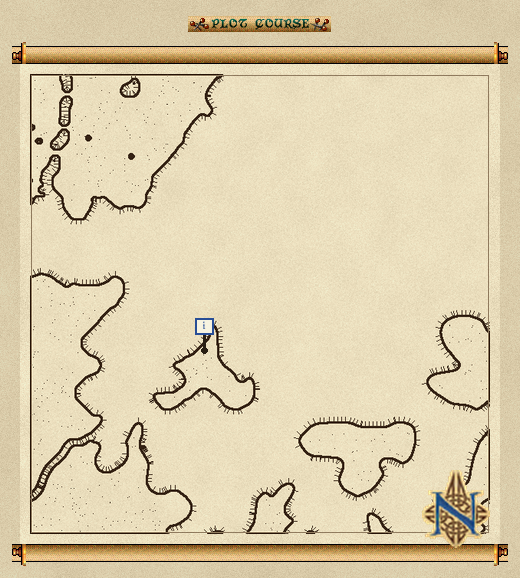
An example decoded map — a 600 × 600-tile slice of Felucca framed with the client’s
map-window parchment art (gump 0x139D), the pin (red X) sitting off-centre at the dig spot,
just as the game places it.
The dig locations
Section titled “The dig locations”There are two ways a chest’s spot can be chosen, and it matters for where you end up digging:
- Classic fixed sites (the traditional “dig spots”).
Data/treasure.cfglists 193 hard-coded Britannia (Felucca/Trammel) coordinates — the well-known treasure spots players think of as the dig locations. These are used byGetRandomClassicLocation()when randomized locations are off. - Our shard’s modern randomized maps. Because
Config/TreasureMaps.cfghasEnabled=True(TreasureMap.NewChestLocations), live maps instead randomize the chest within each facet’s diggable regions (TreasureMap.GetRandomLocation). For Felucca and Trammel that region is the whole map (0,0 → 5119,4095); Tokuno, Malas, Ilshenar, Ter Mur and Eodon use specific rectangles. The picked tile is then validated byValidateLocation— it rejects towns, houses, dungeons, champion-spawn regions, roads, and any non-walkable or non-natural tile (only dirt/grass/jungle/forest/snow are allowed), so chests always land in open wilderness.
The map below plots the 193 classic sites on Felucca so you can see the traditional spread across Britannia. On our shard, treat it as a guide to the kind of terrain treasure favors rather than an exact list of where today’s maps point.
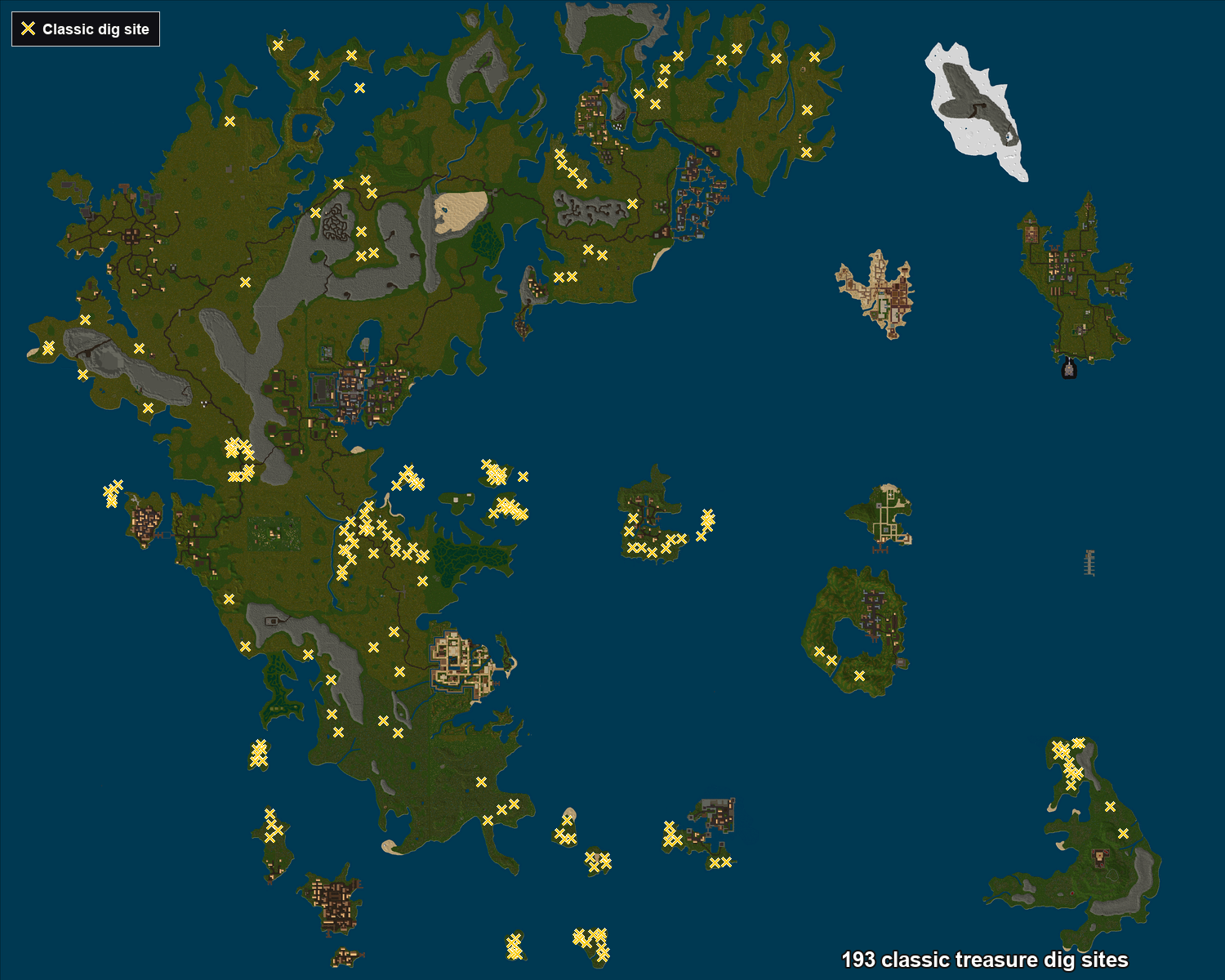
All 193 classic dig sites from Data/treasure.cfg, plotted on the Felucca map.
The chest & loot
Section titled “The chest & loot”Guardians. Completing the dig spawns 4 monsters at the chest
(DigTimer.OnTick). On the modern system each spawn has a 70% chance to be tagged a
(Guardian). They scale to the map level and facet (TreasureMap.Spawn tables) — for
Felucca/Trammel, roughly:
- Stash — mongbats, ratmen, skeletons, zombies, headless ones.
- Supply — orcish mages, gargoyles, gazers, hell hounds, earth elementals.
- Cache — liches, ogre lords, dread spiders, elementals, lich lords, daemons, elder gazers.
- Hoard — ancient wyrms, balrons, blood/poison elementals, titans.
- Trove — blood/poison elementals, cold drakes, frost dragons/drakes, greater dragons.
Opening it. The chest is locked and carries an explosion trap; pick the lock with Lockpicking and disarm with Remove Trap. Chest quality (Rusty / Standard / Gold) is rolled from your Cartography at dig time and boosts the gem, reagent and material counts.
Loot (TreasureMapInfo.Fill), by what’s inside:
- Gold — a bag of gold scaled to level (see the table above), plus a bag of gems whose count grows with chest quality and level.
- Magic equipment — randomly-magic weapons, armor and jewelry themed by the map’s package, in the counts from the level table (6 → 36 items from Stash → Trove).
- Reagents — only on Stash + Mage maps (20/40/60 by chest quality).
- Crafting resources & special materials — on Artisan maps (ingots, boards, leather; imbuing ingredients on Ter Mur, etc.).
- Special / minor-artifact loot & decorations — increasing chance from Supply upward.
- Power scrolls — Felucca only, on Cache and higher, at +110 in the
package’s skills (
GetPowerScrollList). - Scrolls of Transcendence — on most levels except Supply/Cache
(
GetTranscendenceList). - Scrolls of Alacrity — on most levels except Stash (and not Cache on Felucca)
(
GetAlacrityList).
Magic gear and special items are themed by the package and built by
RunicReforging.GenerateRandomItem within a per-level budget. See the
items reference for what the individual drops are.
See also
Section titled “See also”- Cartography · Mining · Lockpicking · Remove Trap
- Seven-GM template · Combat basics · Taming and pets
- Gathering resources · Items reference
Locations plotted from Data/treasure.cfg; map art and the decoded-map parchment are the
client’s own copyright-clean assets.