Plants & Gardening
이 콘텐츠는 아직 번역되지 않았습니다.
Gardening is a self-contained mini-game in Ultima Online: you plant a seed in a bowl of dirt, water it once a day, and over about a week it grows into a plant you can keep as a decoration or harvest for useful materials. It needs no skill points and no combat — just patience and attention. People grow plants for rare coloured varieties (prized for house decorating and resale), for plant resources used in crafting, for plant pigments that dye items, and simply as a relaxing collection game: there are 44 plant types and 19 colours to chase, many of them obtainable only by careful cross-pollination.
All numbers and behaviour below come from the ServUO server-emulator’s plant scripts under
Scripts/Services/Plants/ (cited per section). Structured data lives in data/plants.json,
extracted by tools/extract_plants.py.
How to grow a plant
Section titled “How to grow a plant”The growth loop is:
- Get a seed. Seeds come from full-grown plants you already own (see What plants give you), from monster/treasure drops, and as a quest reward from the Naturalist (see below). A seed records a plant type and a hue.
- Prepare a bowl of dirt. A fresh plant bowl starts at the
BowlOfDirtstage (Scripts/Services/Plants/PlantItem.cs). Pour water on it until the dirt softens — the dirt must be at least lightly watered (Water >= 2) before a seed will take, or you get “The dirt needs to be softened first.” - Plant the seed on the prepared soil. The bowl advances to the
Seedstage and now holds your chosen type and hue. - Water it daily. Pour a beverage containing water on it. The water level runs
0–4 and the plant wants to sit at exactly 2 (
PlantSystem.cs). Each daily growth check the soil dries out by one, so a splash of water a day keeps it healthy. Too much or too little water damages the plant. - Let it grow. Once a day (the growth check runs on a 23-hour timer,
PlantSystem.CheckDelay, and is also re-checked when you log in or the world saves), a healthy plant advances one stage.
The plant must be in your backpack, bank box, or locked down in your house for the
growth check to count (ValidGrowthLocation in PlantItem.cs). You interact with it by
double-clicking it, which opens the gardening gump.
Growth stages
Section titled “Growth stages”The plant climbs through these stages (enum PlantStatus, PlantItem.cs). Internally the
growth check counts stages 1–9; the labelled states the client shows are:
| Stage | PlantStatus | What it looks like |
|---|---|---|
| 0 | BowlOfDirt | An empty bowl. Soften with water, then plant a seed. |
| 1 | Seed | A seed is in the dirt; it will sprout. |
| 2–3 | Sapling | A young sapling, still growing each day. |
| 4–6 | Plant | A recognisable plant; the bowl turns green. |
| 7–9 | FullGrownPlant | Fully grown — shows its type and colour, can pollinate, and yields seeds/resources. |
| 10 | DecorativePlant | ”Set to decorative”: a finished houseplant. No more watering needed. |
| 11 | DeadTwigs | Neglected to death — only twigs remain. |
Once a plant reaches full-grown you can leave it producing seeds/resources, or set it
to decorative (SetToDecorativeGump.cs) — a one-way step that turns it into a permanent
ornament that no longer needs care and can be placed in a house.
The gardening gump
Section titled “The gardening gump”Double-clicking a growing plant opens the main gardening interface
(MainPlantGump.cs). It shows the plant’s art in the centre and a panel of controls: the
reproduction menu, the four maladies (infestation, fungus, poison, disease) with
their current levels, the water level, the four potion slots (poison/cure/heal/
strength), a growth-stage indicator, a help button, and an “empty the bowl” button. The
panel is built from a generic dark frame (gump 0xE10) plus item-art tiles rather than one
bespoke picture.
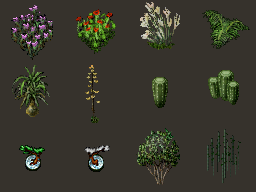
The plant sprites below are rendered straight from the client art for the item IDs in
data/plants.json:
Keeping it healthy
Section titled “Keeping it healthy”A plant has hits (a health pool) and a Health rating of Dying / Wilted / Healthy /
Vibrant. A plant only grows when it is at least Healthy (PlantSystem.Grow), so
keeping it well is the whole job. Health is threatened by four maladies and by wrong
watering (all in Scripts/Services/Plants/PlantSystem.cs):
| Hazard | What causes it | How you treat it |
|---|---|---|
| Infestation | Random each day (more likely on flowery and bright-hued plants, and when over-watered). | Pour a greater poison potion on the plant. |
| Fungus | Random each day (more likely when over-watered). | Pour a greater cure potion. |
| Poison | Caused by over-applying poison potion (it carries over). | Pour a greater heal potion. |
| Disease | Caused by over-applying cure potion (it carries over). | Pour a greater heal potion. |
Each malady runs 0–2. Only the greater potions work — lesser/regular potions give
“This potion is not powerful enough” (PlantItem.ApplyPotion). Potions stack up to 2
charges in the bowl and are consumed on the next growth check, where they cancel out the
matching malady before any remaining health is restored.
Watering matters as much as the maladies. Water sits at 0–4 and the plant wants
2. On each growth check, every point of water above or below 2 deals
3–6 damage, as does each level of each active malady (ApplyMaladiesEffects). Let the
hits fall to zero and the plant dies: a full-grown plant collapses to dead twigs,
an immature one drops back to an empty bowl of dirt (PlantItem.Die).
Beneficial care. If a plant has no maladies and correct water, it slowly heals
(+2 hits per check, or +7 per greater heal potion charge). A greater strength
potion lowers the infestation/fungus chance for the next check by 0.075 per charge. And
planting in fertile dirt (a bag of bones / fertile-dirt bowl) gives a 10% chance to
double-grow — skipping a whole stage — up to stage 5 (Grow).
Neglect is forgiving in one way: the growth check only fires roughly once a day and on login/world-save, so a plant can sit idle without progressing. But the moment a check runs with bad water or untreated maladies, it takes damage — so a long absence with a sick plant is fatal.
Plant types & colours
Section titled “Plant types & colours”There are 44 growable plant types and 19 plant hues (PlantType.cs,
PlantHue.cs). Types fall into categories:
- Default (17) — the everyday garden plants: campion flowers, poppies, snowdrops, bulrushes, lilies, pampas grass, rushes, elephant-ear plant, fern, ponytail palm, small palm, century plant, water plant, snake plant, prickly-pear / barrel / tribarrel cactus. These are the only types that can be cross-bred and that reproduce (make seeds).
- Bonsai (8) — common, uncommon, rare, exceptional and exotic bonsai trees (green and pink variants for the lower tiers). These are special drops; they neither cross-breed nor reproduce.
- Peculiar (18) — decorative-only oddities: cactus, flax flowers, foxglove, hops, orfluer flowers, twisted/straight cypress, short/tall hedge, juniper bush, snowdrop & poppy patches, cattails, spider tree, water lily, sugar canes (bamboo art), and vanilla.
- Fragrant (1) — the cocoa tree (the o’hii tree in older art), source of cocoa.
Hues and cross-pollination
Section titled “Hues and cross-pollination”Seeds carry a hue. The natural starting colours are Plain, Red, Blue, Yellow (the
RandomFirstGeneration set). From these, three derived colours come from mixing primaries
— Purple (red+blue), Green (blue+yellow), Orange (red+yellow) — and each colour
has a Bright variant. There are also five rare hues that don’t come from normal
mixing: Black, White, Pink, Magenta, Aqua, Fire Red (PlantHue.cs).
Colours are produced by cross-pollination (PlantHue.Cross, PlantType.Cross):
- A full-grown crossable plant becomes pollen-producing (
PollenProducing). - Using the gump’s reproduction/pollinate target (
PollinateTarget.cs,ReproductionGump.cs) you pollinate one plant with another. Its seeds then carry the crossed type and hue instead of its own. - Hue crossing rules: same colour → that colour, made Bright; two primaries → their blend (red+blue = purple, etc.); a primary crossed with a non-primary keeps the primary; otherwise the shared component. Any cross also has a 1% chance to yield Black or White — the classic way “accidental” rare plants appear.
- Type crossing nudges toward the average of the two types in the table, so you can walk seeds toward a target plant over several generations.
Only crossable hues/types can be bred, and only reproducing ones make seeds at all
(IsCrossable, Reproduces). The rare hues (Black, White, Pink, Magenta, Aqua, Fire Red)
and the Peculiar/Bonsai types are not crossable — they’re collected, not bred.
A full machine-readable list of every type and hue (with item IDs, category, and the
crossable/reproduces/bright flags) is in data/plants.json.
What plants give you
Section titled “What plants give you”A full-grown plant is a renewable little factory. On each growth check at full size it can
produce (PlantSystem.Grow):
-
Seeds — a pollinated, reproducing plant yields seeds (up to 8 over its life) carrying the crossed type/hue. This is how you propagate and trade colours. Loose seeds and the seed box (
Scripts/Items/Functional/SeedBox/) let you store and sort a collection. -
Plant clippings / resources — certain type + hue combinations drop a crafting material (up to 8 over its life). From
PlantResources.cs:Resource Plant + required hue Red leaves Elephant-ear plant, ponytail palm, or century plant — Bright Red Orange petals Poppies, bulrushes, or pampas grass — Bright Orange Green thorns Snake plant or barrel cactus — Bright Green Cocoa pulp Cocoa tree — Plain Sack of sugar Sugar canes — Plain Flax Flax flowers — Plain Bark fragment Straight or twisted cypress — Plain Vanilla Vanilla — Plain Poppies dust Poppy patch — Plain Note this is why hue matters beyond looks: only the bright colour of a leaf/petal/ thorn plant yields its reagent. Cocoa pulp, sack of sugar and vanilla feed the Cooking chain (chocolate and baking recipes).
-
Plant pigments — full-grown and decorative plant colours can be turned into plant pigments (
Scripts/Services/BasketWeaving/PlantPigment.cs), used to dye items in the plant-colour palette. See the Hues reference for how dyeing colours work on this shard. -
Decorative plants — set a finished plant to decorative and it becomes a permanent potted houseplant for house decorating.
The Naturalist
Section titled “The Naturalist”The Naturalist NPC (Scripts/Mobiles/NPCs/Naturalist.cs) is tied to the Study of
Solen quest. Completing it rewards a random plant seed. Studying an ordinary nest
yields one of the three semi-rare hues (Pink, Magenta, Aqua); studying a special nest
yields a truly rare hue (Fire Red, White, or Black) — a reliable way to seed a
collection with colours you can’t simply breed. (This shard’s Naturalist is a quest giver,
not a plant appraiser/vendor.)
See also
Section titled “See also”- Decorating — placing potted plants and decorative trees in a house.
- House Types — the house shells you’ll lock plants down in.
- Hues — how plant colours and plant pigments fit the dye palette.
- Resources — where plant-grown materials sit among gathered resources.
- Cooking — cocoa, sugar and vanilla from the garden feed baking recipes.
- Professions — a dedicated gardener is a fun, peaceful niche profession.